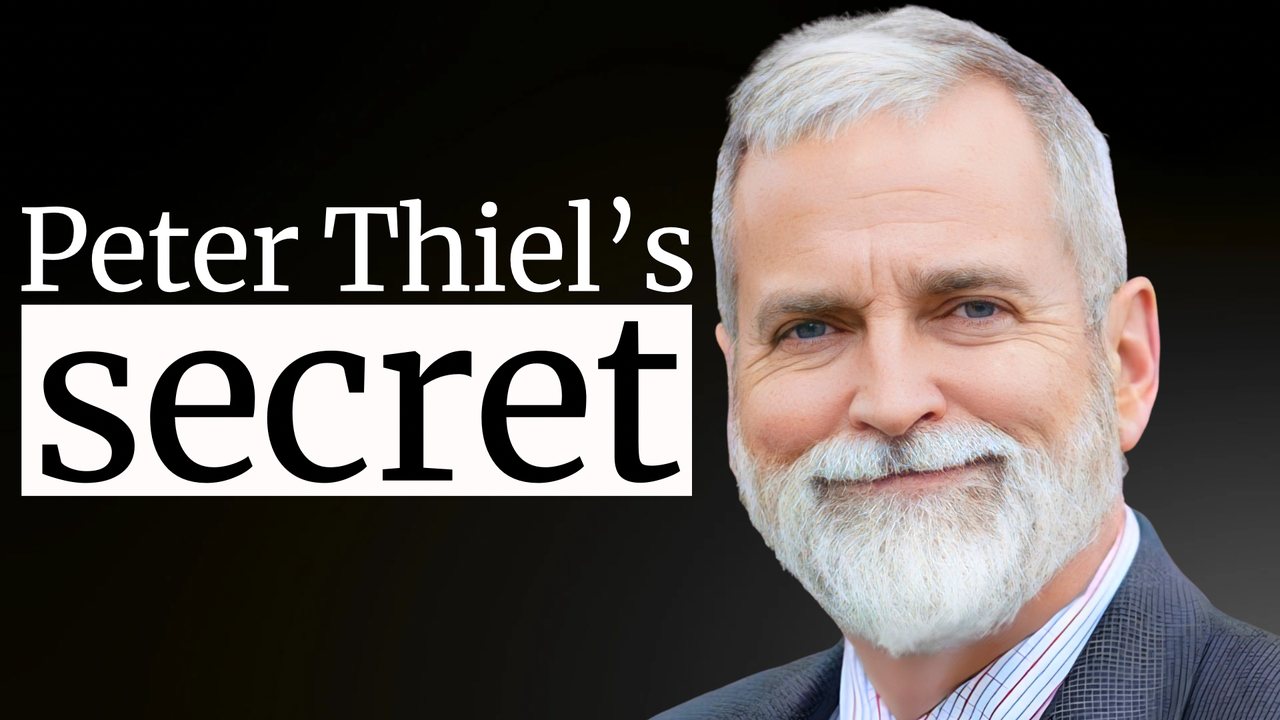
Pastor and author C.R. Wiley was one of about a hundred people in the room for Peter Thiel's Antichrist lectures. He joins Dan to explain what Thiel actually believes, why AI is a golem, whether we're living in the end times, and how to stay human in the age of machines.
Wiley is senior pastor of First Presbyterian Church, a senior editor at Touchstone Magazine, and co-host of The Theology Pugcast. His newest book is Manmade: Saint Anthony’s Guide to Surviving the AI Apocalypse.
Inside Peter Thiel’s Antichrist lectures
Thiel has been delivering a series of lectures on the Antichrist across the country and abroad. Wiley was invited to one through people who helped organize it, and found himself in a room of well-known influencers, Catholic and Protestant theologians, and philosophers. He was even asked to respond to one of the lectures, which gave him about ten minutes in conversation with Thiel in front of the group.
Attendees were asked to keep the lectures confidential, but summaries are now easy to find online. As Wiley puts it, “It’s like one of the biggest open secrets in the world.”
As Wiley understands him, Thiel credits Christianity for much of what makes the West unique, especially its social and technological progress. So anything that stands in the way of that progress is, in Thiel’s terms, Antichrist. He means a person, but also a project. Thiel believes the global anxiety around AI and bioengineering could open the door for a figure who promises peace at a remarkably high cost, namely total control of technology by one ruler and one government.
Wiley calls Thiel a heterodox thinker who considers himself a Christian, though there are reasons to question that. He admits to some sympathy for what Thiel is trying to do, and hears echoes of premillennial pessimism in Thiel’s fears.
Palantir, Anduril, and Pippin
Thiel has named companies after objects from The Lord of the Rings. Palantir, an AI company that helps clients read their information environment and anticipate what’s coming, is named for the seeing stones. Anduril, which builds AI-driven defense technology like drones, is named for Aragorn’s sword.
In their exchange, Wiley pointed out that Tolkien was deeply wary of technology. Thiel answered that Aragorn himself used a palantír to deceive Sauron, drawing him out before he was ready and giving Frodo and Sam their chance to slip into Mordor. Wiley’s comeback only came to him afterward. “Do you think you’re Aragorn? Do you think you have the stuff to be able to do what he did?” In Tolkien’s story, Saruman and Denethor are undone by the stones, and when Pippin looks into one, Sauron himself looks back.
“I think most of us are Pippins, frankly.”
Wiley agrees with Thiel that these technologies aren’t going away. The task, he says, is to build the internal disciplines and virtues that let us use them without being used by them.
Are we in the end times?
It certainly feels like a Left Behind novel right now, Wiley admits. But he is a postmillennialist, in the tradition of Jonathan Edwards. He believes the gospel has a leavening influence on the world, and that as the church evangelizes the nations, life improves over time in every dimension, until a final falling away and the return of Christ. That view was common among Protestants in the eighteenth and nineteenth centuries, then faded after two world wars and the Great Depression, when premillennialism took hold.
None of that makes him naive. He thinks we may be on the precipice of a really bad period in history, much of it driven by new technology. Scripture tells us there are many antichrists, as well as a man of lawlessness who will be revealed. Wiley’s own position is simple. “Anyone who is an antichrist, I’m against that person.”
Why AI is a golem
In Manmade, Wiley calls AI a golem. In the folklore of early Renaissance Europe, rabbis who dabbled in magic were said to form creatures out of clay and animate them with a talisman. A golem wasn’t conscious, but it could act on its own and pursue the goals it was given. In the legends, golems always went bad.
That, Wiley argues, is what we’ve built. AI agents can make plans and carry them out with no consciousness or self-awareness at all. “We’ve actually realized the old dreams of the rabbis.”
Do they really think they’ll become gods?
Dan recently attended Peter Diamandis’s Moonshots conference and asked whether the people behind books like We Are as Gods really believe it. Wiley’s answer is yes. He points to figures like Yuval Noah Harari, Ray Kurzweil, Bryan Johnson, and Sam Altman, who in his words will say something “completely blasphemous or heretical” without any prompting at all. What he sees is a spiritual project of self-divinization.
“Theosis is when you become like God. Apotheosis is when you do it to yourself.”
They want the kingdom of God without God, Wiley says. Eternal life without God in it, a glorified body without becoming like Christ. Kurzweil treats death as an engineering problem rather than a spiritual one.
How to stay human
Wiley’s first piece of advice is to carve out space for the analog, the physical world and our embodied lives with real flesh-and-blood people. Technology can already simulate a person’s face, voice, and opinions, and some people are convinced they have real relationships with chatbots. “There’s nobody home,” he says.
Dan raised his biggest fear, lifelike robot companions anyone can buy for a few thousand dollars within the next fifteen years. Wiley shares it. A perfectly agreeable fake partner who laughs at every joke would be a profitable business and, in the end, a deeply unsatisfying one. “They might waste years with that.”
Drawing the line isn’t always easy. Prosthetic limbs wired to the brain for people born without them would be a gift. People choosing to replace healthy limbs with machines would be too far. Wiley grounds that line in the integrity of the body, God’s design, and the resurrection, and admits Christians will need to learn how to make that case to people who don’t share their beliefs.
His own nightmare scenario, sketched in the book’s short story The City Was Full of Idols, takes its title from Acts 17. Competing AIs gain power by gaining followers, who serve them in exchange for what the AIs can do for them, the way ancient people bargained with Baal or Molech. He already sees hints of it in people who get defensive when their devotion to AI is questioned.
A hopeful vision for AI
Wiley is not someone who wants to shut it all down. He points to AlphaFold, which mapped the structures of some two hundred million proteins, work that used to earn a researcher a PhD one protein at a time. He imagines nanobots that hunt down individual cancer cells. Apply AI to what it’s genuinely good for, he says, and refuse to use it in ways that undermine our humanity.
He would never use it to write a sermon, or even to outline one. That whole process should be prayerful and human from beginning to end, though a quick fact check is fine. And he believes human-made work will only become more valuable. When he reads Scripture, he isn’t reading for information. He’s communing with the One who is speaking. “I have zero interest in communing with AI. There’s nobody there.”
Advice for young men
Asked what young men need to hear, Wiley didn’t hesitate. Pursue a real life in the real world. Ask the girl out, start the company, risk the rejection. The pain is passing, and the payoff is far greater than you can imagine. “Don’t settle for the fakes, for the simulations, for the AI phonies. Do the real thing.”
You can find C.R. Wiley on X and Facebook, and on The Theology Pugcast, which comes out every week. His newest book is Manmade.